
Building a Legacy of Finished Work
- Xitij Thorat

- 2 days ago
- 3 min read
Updated: 8 hours ago
For most of my life, I assumed productivity was a problem of generating better ideas. The more I learned, the more I realized the opposite was true. Ideas are rarely the bottleneck. Execution is.
The challenge is not how to think of more things. The challenge is how to create meaningful work in a world where new possibilities appear faster than we can pursue them. I eventually arrived at a simple framework that helps me manage both creativity and focus:
Think → Create → Appreciate → Release → Next.
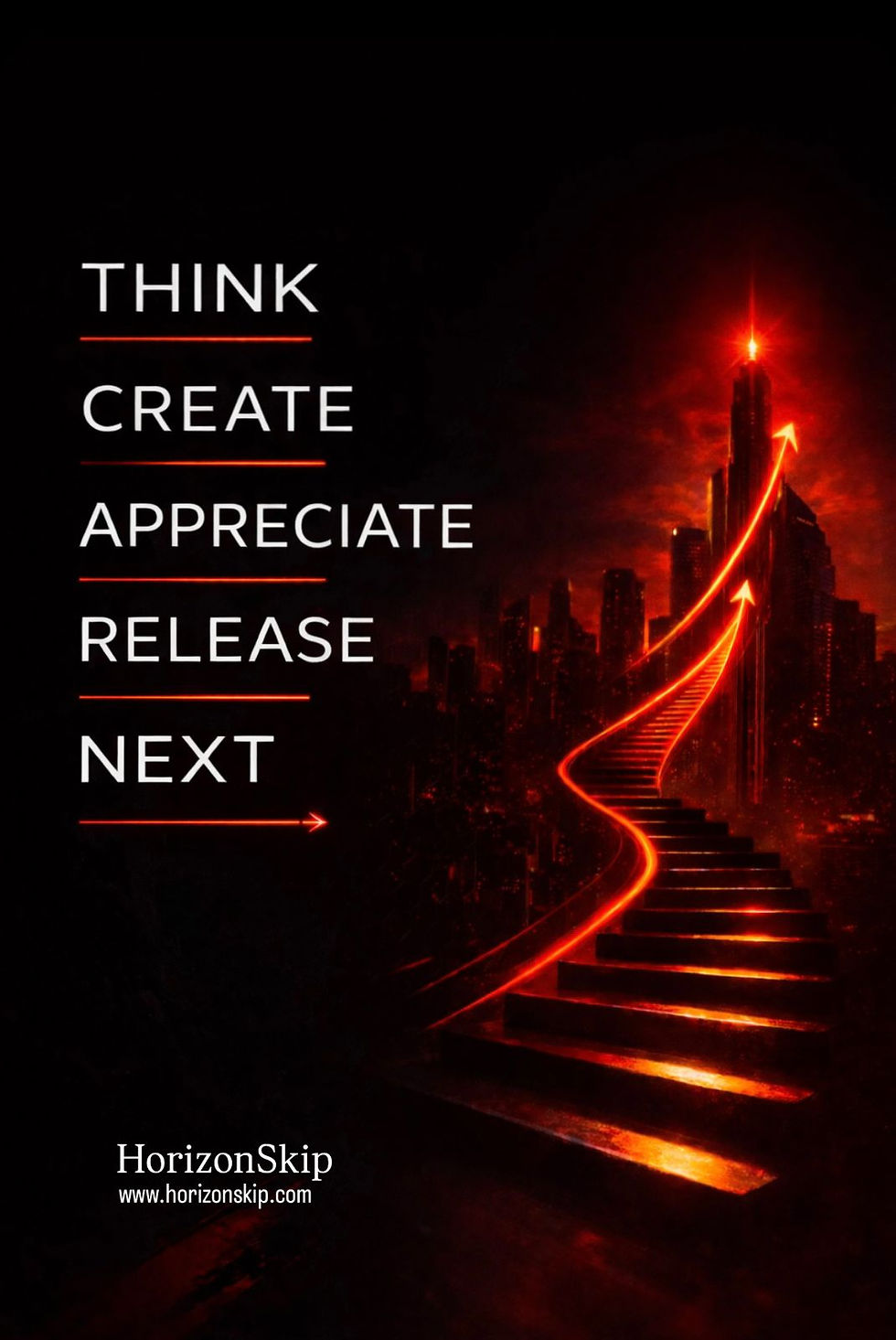
At first glance it looks like a motivational slogan. In practice, it functions as an operating system.
Think
Thinking comes naturally to many creative people. Ideas appear unexpectedly while walking, reading, working, exercising, or building something entirely unrelated. New projects, businesses, stories, products, and systems emerge almost continuously. The traditional advice is often to suppress distractions. I have found that approach ineffective.
Ideas are not enemies. The real problem occurs when every idea immediately demands execution. Instead of fighting thoughts, I capture them. This is where "Idea Vault" enters the picture. The vault exists for a single purpose: containment.
When an idea appears, I record it. I do not evaluate it. I do not expand it. I do not start building it. I simply preserve it. This allows thinking to remain free while protecting focus.
Create
Creation is where constraints become valuable. While thinking can be unlimited, execution cannot. For that reason I organize work into what I call runs.
A run is the project currently occupying the highest level of attention. Only one run exists at a time. This rule sounds restrictive, but it solves a common problem among ambitious people: project forking. Many projects fail not because they are bad ideas but because they compete with three other exciting ideas launched halfway through development.
A run creates commitment. New ideas are allowed to appear, but they are redirected into the vault. The active project remains active. Focus is protected. Progress accumulates.
Most importantly, things get finished.
Appreciate
This may be the most overlooked stage.
Builders often move directly from one challenge to the next. A project finishes and the mind immediately searches for a larger mountain to climb.
The result is a strange form of success without satisfaction.
Appreciation interrupts that cycle. It creates a deliberate moment to recognize effort, growth, lessons learned, and accomplishments. Appreciation is not complacency. It is acknowledgment. Without it, even meaningful achievements can feel empty because they disappear beneath the pressure of whatever comes next.
Release
Not every project deserves permanent attention.
Many people unintentionally become caretakers of every system they have ever built. Over time this creates a collection of obligations rather than accomplishments. Release solves that problem.
When a run is complete, I consciously decide what happens next. Some projects are finished and can be released entirely. Others continue operating in the background as maintenance systems.
Either way, they leave the top position. The active run slot becomes available again. Release prevents success from becoming burden.
Next
The final stage is deceptively simple. Choose what comes next.
The next run may emerge from the Idea Vault. It may be a brand-new opportunity. It may be the most important unfinished challenge available.
Whatever the source, it receives full attention. The cycle begins again.
Think.
Create.
Appreciate.
Release.
Next.
The Staircase of Finished Work
The poster I created for this framework shows a staircase rising toward a distant tower. What I find interesting is that the image changes meaning depending on where attention is placed.
Most people focus on the tower. I focus on the staircase.
The tower represents a future achievement that may never fully arrive. The staircase represents the process that always exists. Each completed run becomes another step. Another finished artifact. Another contribution. Another lesson.
Progress is no longer measured by dreams but by completed work.
Building Legacy Differently
People often talk about legacy as something dramatic and distant. In reality, legacy emerges from repetition.
A finished business.
A completed game.
A published book.
A useful framework.
A meaningful project.
None of these need to change the world individually. Over decades, however, they accumulate. The result is a body of work that tells a story about what mattered enough to finish. That is why the most important insight in this framework may be the simplest:
A run must end.
Without endings there are no completed works.
Without completed works there is no legacy.
By allowing ideas to flow freely, containing them in a vault, committing to one run at a time, appreciating accomplishments, releasing completed projects, and moving deliberately to the next challenge, it becomes possible to transform creativity into something tangible.
Not a collection of plans.
A collection of finished things.
And over time, that collection becomes the clearest expression of who we are and what we chose to build.

Comments